Rod of Many Tools Rod, uncommon (+1), rare (+2), very rare (+3)
This ten-inch rod’s handle is encased in a seasoned wood and capped with a thick nob of brass-coloured metal on either end. The rod always feels heavier than you think. When it takes the form of a tool the metal on either end reshapes to make up the necessary components required of the tool.
This rod is able to take the shape of a variety of tools. As an action, you can touch the item and transform it into any type of artisan’s tool of your choice, or any one-handed or two handed simple or complex tool. Resetting the rod is a free action, transforming the rod still takes an action. The Rod of Many Tools reshapes and expands the metal knobs on each end to the shape of the tool, the rod’s magic allows flexible components and moving parts. When used by a character as part of a relevant skill or profficiency roll the Rod of Many Tools gives a bonus equal to the bonus of the rod, this bonus is determined by the rod’s rarity.
If used as a weapon the Rod is treated as a Slashing(Axe or Blade), Piercing(Pick or Needle), or Bludgeoning(Hammer) weapon upon transformation to a practical form. A one handed weapon does 1d6 of the relevant damage, a two handed weapon does 1d8 damage. The weapon does benefit from the item’s bonus and is treated as a magical weapon.
Everready Medic’s Bag Wonderous item, Uncommon, Rare, Very Rare (Requires Attunement) The Everready Medic’s Bag is a healer’s kit that automatically regenerates 1 use per day as the magic restocks the necessary bandages and medicines. Unlike a healer’s kit the Everready Medic’s bag may be used to enhance a short rest. By spending 1 use you may patch up a single character taking a short rest allowing them to add your Proficiency Bonus to their Hit Dice for healing purposes, this can be done for as many characters as the bag has charges within the short rest’s allowable time. The Everready Medic’s Kit gives a +1 bonus to Medicine Skill checks and has an additional effect dependent on rarity.
Uncommon: Allows the user to use the Spare the Dying cantrip
Rare: As Uncommon but also allows the user to cast revivify 1/long rest
Very Rare: As Rare Also allows the user to cast Greater Restoration 1/long rest
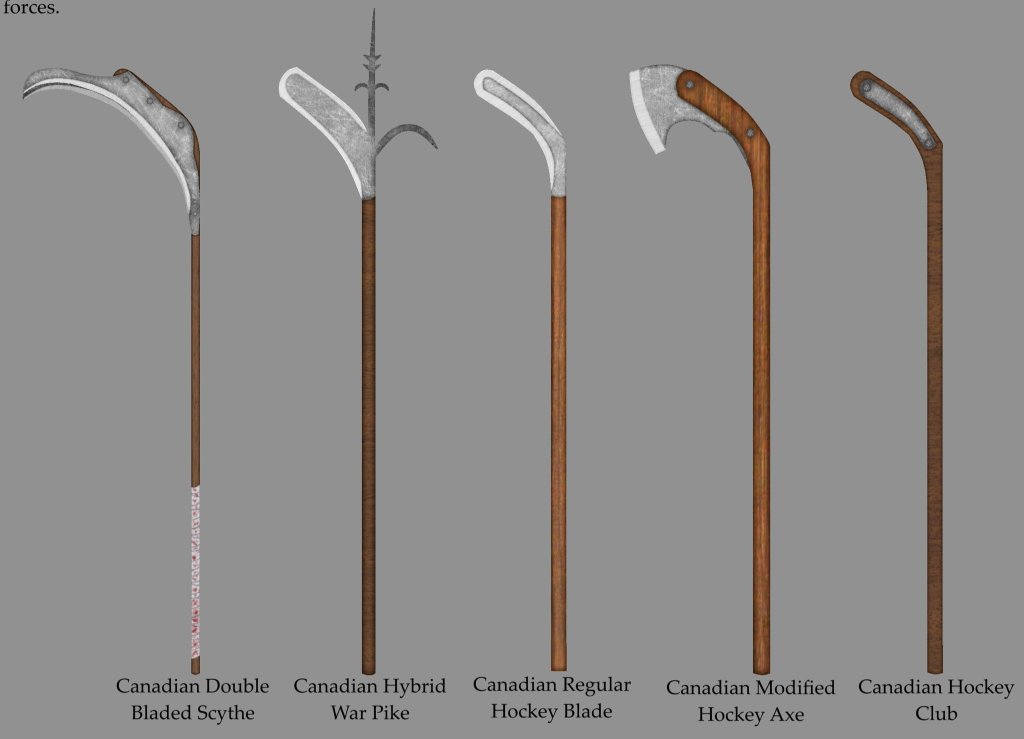
I often have issues with inspiration. It’s easier to work with others so that not only your ideas have people to bouce off, but the ideas being thrown about can outright inspire yet more ideas. This tends to be why I zone out to various image aggregating/storing websites, sometimes something jumps out at me and I think, “Yep, that’s inspiration.” Well, I saw this image:
Credit to Marcus Vance for posting it but I cannot seem to find the original source, (to my frustration I might add. Any reader who knows where this is from please email I’d love to give fair credit.)
So I’m going to have a bit of fun and Give stats for these abominations of war for D&D 5e. (I could be convinced to do the same for other games but I did it in 5e because it was popular back in the day.)
Canadian Hockey Club Modified from a winter game-stick to be a useful peasant’s weapon, the “blade” of the Canadian Hockey Club has been reinforced with metal plates to help it survive rough handling without breakage. Damage: 1d6 Bludgeoning Weight: 5 lb Qualities: Reach, Range (40/80), Two Handed
Canadian Modified Hockey Axe The addition of a riveted axe blade turned the childhood item of play into an effective halberd for any militia solider without compromising it’s use as a launcher of missiles. This was an evolution of the Canadian hockey club making it more effective as a weapon. Damage: 1d10 Slashing or 1d6 Bludgeoning Weight: 9 lb Qualities: Complex, Heavy, Reach, Range (40/80), Two Handed
Canadian Regular Hockey Blade First design implemented globally across commonwealth military, the false edge implemented along the bottom of the blade maintained it’s use as a ranged weapon while the sharp edge at the tip and along the inside allowed devastating wounds against opponents with the benefit of reach and prescision. Damage: 1d8 Slashing/Bludgeoning Weight: 6 lb Qualities: Finesse, Range (40/80), Reach, Variable(Bludgeoning), Two Handed
Canadian Hybrid War Pike Despite fearsome appearance the Canadian Hybrid War Pike was never implemented outside of it’s use in ceremonial parade. While effective as a pike the primary advantage of the weapon in both Melee and ranged engagement never saw it’s use except as an emergency weapon. Described as “too hard to clean afterwards” and “useless in woodland skirmishing” by those familiar with the engagement methods. Damage: 1d8 Slashing or 1d6 Piercing Weight: 8 lb Qualities: Finesse, Reach, Two Handed
Canadian Double Bladed Scythe Favored by Canadian shock troops and similar elite units the Canadian Double Bladed Scythe is an example of the Canadian dry gallows humour. Named because of it’s cutting edge as well as a hockey stick’s still functional “blade,” this weapon is unwieldy in untrained hands but experts have learned to maximize this scythe’s weight to brutal effectiveness in each strike. Astonishly, those same experts are still able to launch a puck with nigh equivelent accuracy. Damage: 2d6 Slashing or 1d8 bludgeoning Weight: 10 lb Qualities: Brutal, Complex, Exotic, Heavy, Reach, Range (30/60), Two Handed, Unwieldy (Str 16, Dex 14)
Ammunition The Puck Made originally from a combination of Leather, rope, sinew, and now commonly rubber, the puck has not terribly evolved from it’s origins as a ball on the ice. However due to it’s construction and the necessity of the material elasticity the puck has remained a weighty and dangerous projectile. Damage: 1d6. Bashing. Qualities: Ricochet
The Berry-Shot Puck An independent evolution to grapeshot, the Berry-shot puck was constructed to break apart after launch to maximize the probability of hitting small game birds and small game. Popular due to it’s opportunistic design, it’s also a favorite of ex-military poachers. Damage: 1d6 Bashing. Qualities: Hunting (small game & birds).
The Bodkin Puck Unlike it’s cylindrical cousins the bodkin puck is a cube of metal made with very angular points. Capable of piercing heavier armor this deadly ammunition made the Canadian feared by Heavy Troops and Cavalry. Damage: 1d6. Piercing Qualities: Armor-Piercing
The Flechette Puck Essentially a barbed caltrop enveloped in a fragile ball of resin. The resin breaks on contact with a target allowing the barbs to sink into flesh. Though especially grizzly, these weapons became effective means of wounding troops to take alive. Damage: 1d6 Slashing. Special Qualities: Barbed(1d4)
The Puck-de-Corbin Named not after a Corvid’s beak but after a Corvid’s reputation on the battle field, these pucks were designed to maximize their range without sacrificing their ability to deliver a hit or ricochet off of a nearby target. An early application of the airfoil to maximize distance while maintaining effective force. Damage: 1d6. Qualities: Ricochet, Sail
Qualities: Armor-Piercing – Damage from ammunition against Heavy Armor gains advantage on hit. Barbed – Ammunition is designed to stick inside the target, removing the ammunition without a DC 20 Heal Check with a healer’s kit or equivalent tools causes listed damage. Complex – The weapon has more than one source of damage, the wielder chooses which damage to apply when used in an attack. Hunting – the weapon is designed to hunt certain game more effectively, attack and damage is given advantage against the specific kind of target (or approximate equivalent). Ricochet – Exceeding target AC by more than 5 allows the wielder to strike another target within 10ft of the last target, but damage from a ricochet is disadvantaged on the roll. Sail – Ammunition increases the normal range of the weapon when used. Unwieldy – Due to construction or complexity this weapon has a stat requirement to use with proficiency, the character must have the stat to use the weapon with proficiency. Variable – Designed to do more than one type of damage, will list the secondary type.


 Eldritch Word